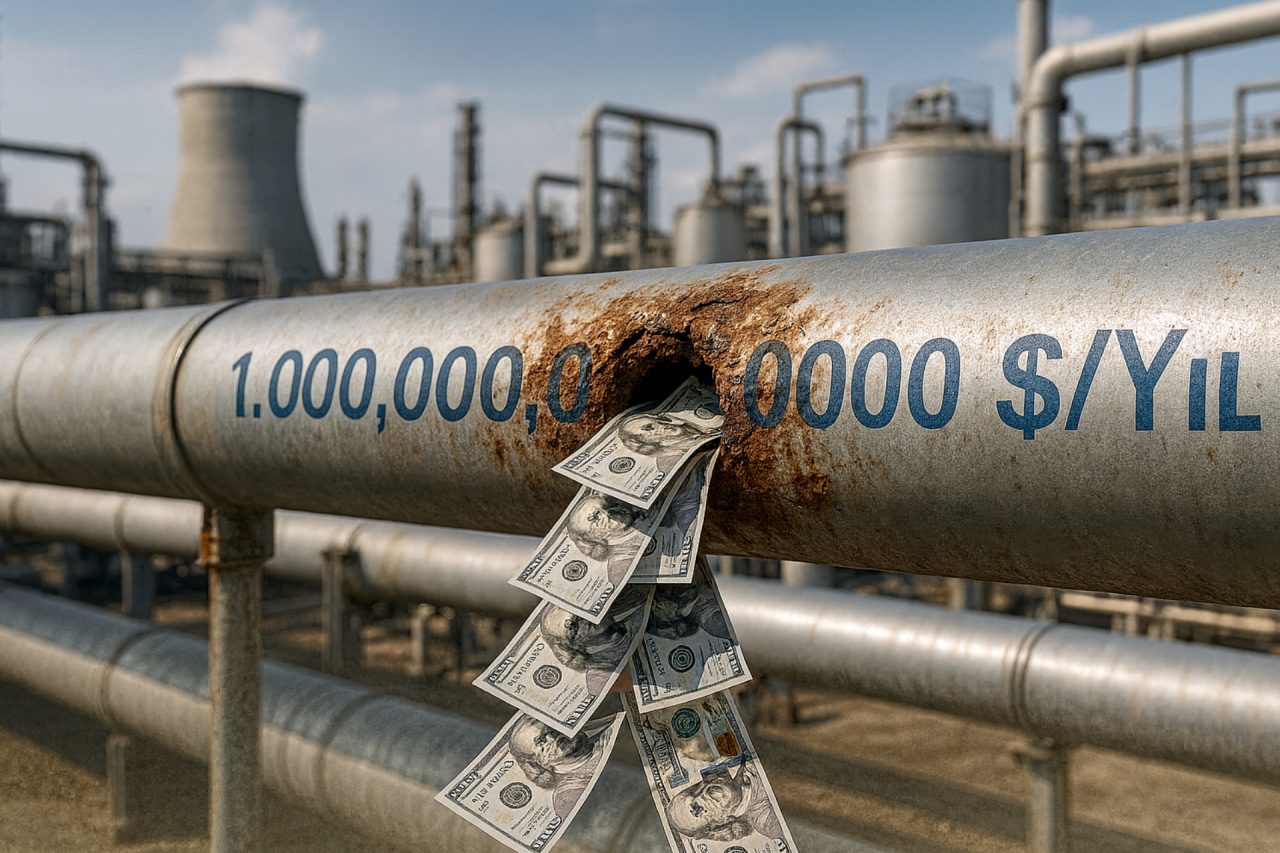

The burdensome cost of Corrosion Under Insulation (CUI) – ~ $1,000,000,000,000 /Year
The World Corrosion Organization estimates that corrosion costs the global economy $2.2 trillion annually. According to their figures, almost 45 percent of this corrosion cost—about $1 trillion—occurs in the oil, gas, and petrochemical industries, affecting onshore and offshore operations. Corrosion Under Insulation (CUI) is recognized as a critical problem faced by plant operators.
It is estimated that 40-60% of pipe maintenance costs are a result of CUI, and 10% of the total annual maintenance costs in these sectors are devoted to repairing damage caused by CUI. Severe CUI cases can risk personnel, the environment, and industry reputation. Despite the numbers and awareness regarding insulation materials, little research exists on the best method to prevent CUI to extend pipe life and optimize safety.
Insulation is primarily installed for heat/cold protection, freeze protection, process control, personnel protection, sound control, condensation control, or fire protection. It is accepted that the type of insulation chosen plays a significant role in the system’s overall ability to mitigate CUI. For example, the following material properties have been found to have the greatest impact on CUI: the closed and open cell (porous) structure of the insulation material, water absorption, permeability and retention, soluble chloride levels, and coating selection.
Insulation alone cannot protect plant components against corrosion, but appropriate insulation systems can effectively support the reduction of corrosion. The selection of the insulation system determines whether the insulation resists the ingress of water or water vapor and minimizes the risk of corrosion, or if it allows or even potentially accelerates corrosion processes.
Corrosion Under Insulation (CUI) in industrial piping is a major problem for the oil and gas industry. The potential effect of thermal and acoustic insulation materials is normally assessed through a series of individual laboratory tests on the insulation materials themselves, but very rarely on the installed system. Furthermore, the physical values tested do not necessarily and easily reflect the “CUI” risk of a particular insulation material or system.
A more complex approach has been suggested that takes into account not only the applied insulation system but also CUI failure behavior and water or water vapor ingress and retention processes. This approach allows for individual risk assessment of applied insulation systems against different water ingress scenarios.
Other factors influencing the risk assessment include the configuration of the insulation system (e.g., insulation materials, aluminum barrier foil, outer jacketing/cladding) and the specified construction or installation methods.
This blog series is designed to enable the reader to improve their knowledge of insulation materials and their impact on CUI risk, and also to better identify sensitive areas within a plant where CUI is likely to occur, thereby allowing appropriate CUI management strategies to be developed and implemented.